

The Hold Music Nightmare: Why You Need to Speak to an Aeroplan Agent and How to Skip the Line
Summary
Calling customer service for your travel rewards is rarely a joyful task. While Canada’s premier airline loyalty program offers spectacular value for global travelers, the physical act of redeeming those rewards often involves legendary wait times, convoluted automated voice menus, and a significant emotional toll. Despite massive investments in digital self-service platforms, there are critical moments where you absolutely must speak to an Aeroplan agent to secure your dream vacation. This article dissects the primary reasons why members are forced to pick up the phone, investigates the debilitating psychological and logistical challenges of the inevitable hold queue, and introduces a revolutionary agentic assistant, LTS. LTS is designed to reclaim your time by handling these excruciating phone chores—and navigating the hold music—entirely on your behalf.

Introduction: The Hidden Time Tax of “Free” Travel
Everyone loves the dream of a “free” vacation. We diligently collect loyalty points, strategize our daily credit card spend, and map out complex dream itineraries to Tokyo, London, or the Maldives. In Canada, Aeroplan is the undisputed heavyweight of these loyalty programs, offering unparalleled access to Air Canada’s vast domestic and international network, as well as the prestigious, globe-spanning Star Alliance.
However, a hidden tax heavily applies to these dream trips: the “phone chore” tax.
While digital platforms and mobile apps have streamlined basic, straightforward round-trip bookings, a surprisingly significant portion of the most valuable, complex, or urgent transactions require human intervention. When digital systems fail, throw up cryptic error codes, or simply lack the programming capability to handle your specific request, you are left with exactly one option: dialing the 1-800 number to speak to an Aeroplan agent.
This isn’t just a minor logistical hurdle; for many, it is the beginning of a modern, hours-long nightmare. This article will thoroughly explore the underlying reasons why you are compelled to call, dissect the anatomy of the agony that follows in the hold queue, and provide a technological blueprint for how you can bypass this archaic process forever using LTS.
Part I: The Top Reasons You Must Speak to an Aeroplan Agent
Despite a massive corporate push toward digital self-service to reduce call center overhead, the sheer complexity of a global airline alliance means millions of calls still flood contact centers annually. Travelers are not calling because they enjoy the hold music or crave a chat; they are calling because the digital infrastructure has forced them to. Here are the top scenarios where you have no choice but to speak to an Aeroplan agent.
1. The Maze of Complex Partner Airline Bookings

This is the holy grail of maximizing reward redemption, and consequently, the number one source of phone-based frustration. While you can book standard Air Canada flights online with relative ease, the website’s booking engine frequently struggles to process complex itineraries involving Star Alliance partners (like All Nippon Airways, Singapore Airlines, Lufthansa, or United) or non-alliance partners (like Emirates, Etihad, or Oman Air).
Digital interfaces often fall victim to “ghost availability”—a frustrating phenomenon where seats appear available on the search results page, but when you click through to finalize the booking, the system throws an error. Furthermore, the website algorithm cannot always construct convoluted, multi-city itineraries that technically adhere to the program’s intricate routing rules and maximum permitted mileage boundaries.
The Pain Point Scenario: If your dream honeymoon requires flying Air Canada to London, connecting on EgyptAir to Cairo, and returning via Lufthansa through Frankfurt, the website will almost certainly crash at the final pricing stage. You are forced to speak to an Aeroplan agent who can manually construct the ticket, segment by segment, using their legacy backend booking terminals.
2. Infant Ticketing and Lap Child Glitches
One of the most notoriously broken aspects of airline reward bookings across the industry is adding an infant (under two years old) to an adult’s award ticket. According to policy, adding a lap infant on an international itinerary typically costs a flat fee of 2,500 points or a highly discounted cash rate.
However, attempting to execute this online often results in catastrophic system failures. The website might try to charge the infant the full adult point fare, or it simply refuses to issue the ticket entirely. Parents attempting to secure family travel are routinely forced to book the adult tickets online to secure the limited award space, and then immediately call in and wait for hours to speak to an Aeroplan agent just to manually attach the infant ticket to the reservation before the flight departs.
3. Wrestling with Dynamic Pricing and “Instant” Changes
Air Canada flights are subject to dynamic pricing, meaning the point cost fluctuates constantly based on cash price, historical demand, and complex revenue management algorithms. When a frequent flyer spots a “sweet spot” (a surprisingly low-point-cost flight), they must act instantly.
The problem arises when the online system refuses to finalize the booking at the advertised price. You might see a business class seat for 60,000 points, but at the final “Pay” screen, an error message appears, or the price suddenly jumps to 110,000 points due to a caching lag. When milliseconds count and a massive points difference is on the line, the member has no choice but to dial in, wait on hold, and speak to an Aeroplan agent to demand they honor the price that was displayed online. This creates an immediate, high-stress phone chore.
4. Managing Elite Status, Priority Rewards, and eUpgrades
The ongoing changes to Elite Status criteria and rewards have introduced a fresh wave of complexity. Navigating Status Qualifying Miles (SQM), Status Qualifying Dollars (SQD), and especially applying eUpgrades often requires a human explanation.
The eUpgrade digital interface is notoriously buggy. It might clearly display “Upgrade Available” with a green checkmark, but when an Elite member tries to apply their hard-earned credits, the system spits out a generic error. Furthermore, applying Priority Reward vouchers (which offer 50% off the base point cost of a flight) to complex partner bookings often breaks the online pricing engine. Sorting out exactly why you can’t upgrade a confirmed booking, or applying a voucher that the website refuses to recognize, guarantees you will need to speak to an Aeroplan agent at the elite desk.
5. Involuntary Schedule Changes and the “Rebooking Loop”
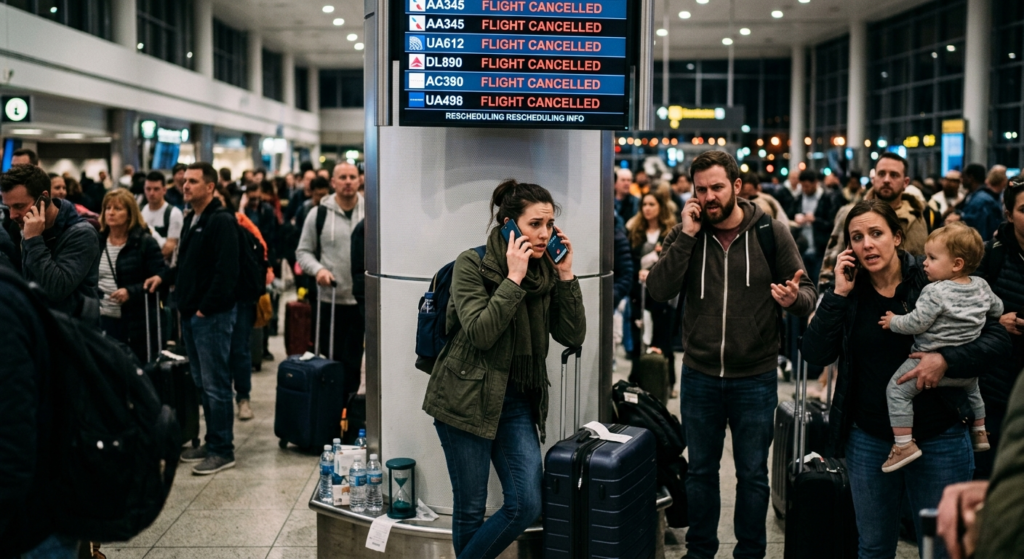
When an airline alters its schedule or cancels a flight you booked with points weeks or months in advance, you are pushed into a nightmarish logistical loop. The automated rebooking system is devoid of logic; it might rebook a simple five-hour direct flight into an unusable 36-hour itinerary with three overnight layovers.
To fix an involuntary schedule change and be placed on a reasonable alternative flight, the digital tools are utterly useless. You must speak to an Aeroplan agent. The websites are generally not equipped to handle complex re-accommodation rules for reward bookings, especially when multiple partner airlines are involved, forcing the agent to manually liaise with the partner airline’s liaison desk to open up new award space.
6. Missing Transactions and Point Disputes
Not every point you earn magically appears in your account. If you flew on a partner airline (e.g., Turkish Airlines or TAP Air Portugal), stayed at a partner hotel, or initiated a transfer from a financial partner, the automated tracking sometimes fails.
The online form for requesting missing points is a valid starting point, but if that automated request is rejected—often due to a minor name mismatch in the partner’s system (e.g., a missing middle name)—the digital road ends. The user must then initiate a phone chore, wait on hold, and speak to an Aeroplan agent to provide manual proof of travel, ticket numbers, or boarding passes. These are tedious, highly administrative calls that people dread, but must make to claim their hard-earned rewards.
Part II: Anatomy of an Agony: The Challenges of Wait Times
Understanding why we are forced to call is only half the story. The real pain—the core of the “chore”—is what happens between dialing the number and finally hearing a human voice. The hold experience is unique in its capacity to drain both your temporal and emotional resources.
The Psychological Weapon of the “Estimated Wait Time”
The first psychological barrier you hit is the IVR (Interactive Voice Response) system. You navigate a labyrinth of numbers, repeatedly speak your account ID to an uncomprehending voice recognition software, and are finally met with a pre-recorded statement: “Due to higher than normal call volumes, your estimated wait time is… longer than two hours.”
This estimated time is not just information; it is a psychological weapon. It forces the caller into an immediate, stressful cost-benefit analysis. “Is fixing my eUpgrade worth two hours of my life? Can I afford to lose this morning?” The cruelty of this system is its sheer lack of precision; “longer than two hours” could mean 121 minutes, or it could easily stretch into a four-hour ordeal during a winter storm or a major system migration.
The Time Tax: A Literal Theft of Productivity
If you are stuck on hold for three hours, those are three hours of stolen productivity. This is the ultimate “time tax.”
For a working professional, that is nearly half a workday paralyzed by a background task. For a parent, it consumes the entirety of the precious window between finishing work and managing their children’s bedtime. For a traveler already on the road, it is time that should be spent exploring a new city, now wasted staring at a hotel room wall. You cannot effectively take another important phone call, you cannot move to a noisy environment, and your attention is constantly divided. It is a functional “stay-at-home order” issued by a corporation’s lack of staffing.
The Sensory Deprivation of Hold Music
There is a specific, agonizing form of sensory deprivation associated with airline hold music. It is usually composed of two contrasting, equally terrible elements: either an infuriatingly cheerful, synthesizer-heavy tune that loops every 40 seconds, or a piece of classical music played through a severely compressed, low-bitrate connection that makes a grand symphony sound like it’s being performed underwater through a tin can.
Listening to this repetitive loop for hours is not a neutral experience. It actively induces anxiety, irritation, and eventually, a form of mental exhaustion. The music is mercilessly punctuated by periodic, false-hope recordings: “Your call is important to us… please continue to hold to speak to an Aeroplan agent.” These messages trigger an involuntary spike in adrenaline and attention, followed by the crushing disappointment that it is still just a machine.
The Disconnection Nightmare
This is the ultimate dread of the phone chore, the scenario that haunts frequent flyers. You have survived three hours of hold music. You have psychologically prepared yourself for the negotiation. You hear the final click—the music stops, a transfer tone rings—and then… a dial tone. The line drops.
The emotional crash of a dropped call after an extended wait is devastating. There is no direct callback number. You have to start over. You have to redial. You are back at the absolute end of the line. This singular, pervasive fear keeps people tethered to their phones in unnatural positions, terrified that moving an inch or switching to another app might sever the connection.
The Aggression Carry-Over

Finally, wait times severely degrade the eventual human interaction. By the time a customer manages to speak to an Aeroplan agent, they are rarely calm or polite. They are deeply frustrated, angry, and exhausted. The agent—who did not cause the wait time and is likely overworked—inherits this aggression. The call begins defensively, extending its duration, raising the blood pressure of both parties, and drastically reducing the likelihood of a pleasant, creative, or efficient resolution. This single phone chore has effectively ruined the user’s mood for the entire day.
Part III: Skipping the Line: How LTS Reclaims Your Life
Life’s Too Short (LTS) technologies was founded on a simple, liberating, and undeniable concept: Phone chores are a colossal waste of human life. We fundamentally do not believe you should have to spend three hours of your precious day listening to corrupted classical music just to claim the flights or eUpgrades you have rightfully earned.
This is precisely why we created LTS.
LTS is not just another basic app. It is not a simpler menu system. It is a highly advanced, agentic AI-driven phone call assistant designed to execute complex phone chores on your behalf. ### How LTS Interacts with Airlines (So You Don’t Have To)
When you are faced with any of the pain points described above—a complex partner booking error, a lap infant ticketing nightmare, or a dynamic pricing dispute—you do not dial the contact center. You do not subject yourself to the queue. Instead, you activate LTS.
Through our secure, intuitive interface, you provide LTS with the exact parameters of your phone chore. This includes securely providing your loyalty credentials, the specific nature of your problem, and your desired outcome (e.g., “Speak to an Aeroplan agent to book Air Canada flight AC860 for 30,000 points and add a lap infant,” or “Apply my eUpgrades to booking reference code XYZ123 that the website is rejecting.”).
Once the parameters are set, LTS takes over completely.
The LTS Advantage: The Power of True Delegation
1. Zero Wait Time for You
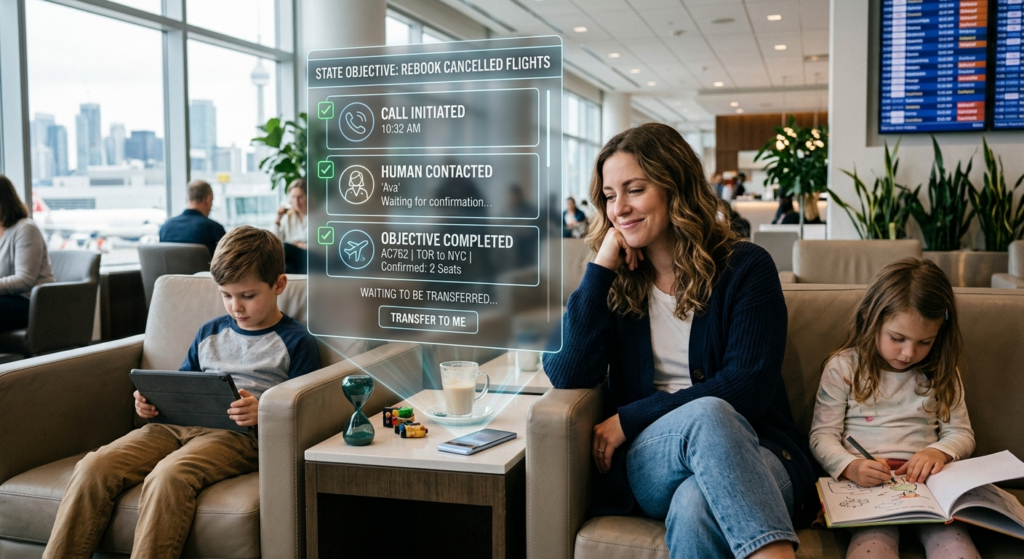
When LTS executes the phone chore, you are completely and instantly removed from the agonizing process. LTS dials the number. LTS flawlessly navigates the convoluted IVR trees, speaking your account credentials to the automated system. Most importantly, LTS waits on hold.
While LTS endures the tinny music and the repetitive false-hope recordings, you are entirely free. You can continue working, attend critical meetings, be fully present with your family, go to sleep, or take a walk. Your productivity and your peace of mind are no longer held hostage by an airline’s contact center staffing levels.
[IMAGE PROMPT: A photo-realistic, joyful slice-of-life image. A person is laughing freely while building a wooden block tower with their young child on a sunlit living room floor. On a nearby coffee table, completely ignored, a smartphone is visible. Its screen is dark, but next to it is a small, glowing green LED indicator (representing LTS actively running). The focus is sharp on the happy family, with a soft, artistic blur on the phone.]
2. Expert Negotiation (Agentic Presence)
LTS is not a passive placeholder bot that simply rings your phone when a human answers. It is an agentic assistant. This means it has a sophisticated level of agency to actively achieve the outcome you requested. LTS isn’t just holding the line; it is fully equipped to speak on your behalf when the agent finally picks up.
Our LTS models are deeply trained on complex airline service protocols, routing rules, and terminology. When the live representative answers the phone, LTS identifies itself and professionally articulates your exact request: “Hello, I am an AI assistant calling on behalf of Sarah, with the following Aeroplan number ###-###-###. They are attempting to book a Star Alliance itinerary that is failing online due to a phantom availability error on the Taipei to Manila segment. The segments they need are…”
LTS can handle routine security verification, provide complex itinerary details, spell out passenger names phonetically, and execute multi-step booking instructions without ever requiring your input.
3. Smart Escalation and Seamless Finalization
If the call reaches a highly complex stage where a nuanced, personal decision is required—for example, the agent states, “The specific flight they wanted is gone, but I can put them on a flight two hours later for 5,000 points more. Should I book it?”—LTS is designed to handle this gracefully.
LTS can be pre-configured by you to make decisions within a specific threshold (e.g., pre-approving point variations up to 10%), or it can instantly text you a dynamic prompt for real-time approval, all while politely keeping the live agent engaged on the line.
Once the chore is finally complete, LTS secures the reservation, verifies the ticketing confirmation code, ends the call, and sends you a comprehensive final report. You only engage when the problem is already solved.
A Future Without Phone Chores
We live in an age of incredible automated brilliance, yet our customer service model remains stubbornly stuck in the 20th century, demanding hours of our undivided human attention as a “cover charge” for basic service.
Having to speak to an Aeroplan agent is a necessary reality for the modern frequent traveler navigating complex reward systems, but the agonizing “phone chore” associated with reaching them is not. The technology now exists to completely delegate these logistical nightmares.
Your time is your most finite, most valuable asset. It is meant for deep productivity, for meaningful connection, for joy, and for actually experiencing the incredible global destinations your hard-earned points are taking you to. Your time is absolutely not meant for enduring hold music.
It is time to stop waiting. It is time to embrace delegation.
Call to Action: Take Back Your Time Today
Do not let another three-hour theft of your day happen to you. The next time you encounter an “Error 404” on a reward search, need to wrestle for an eUpgrade clearance, or have to fix a cancelled flight, do not dial the contact center. Activate LTS.
Experience the profound freedom of true technological delegation. Let our agentic assistant handle the frustration, the hold music, and the negotiation while you live your life.
Sign up for LTS today and never spend another minute waiting to speak to an agent.
Frequently Asked Questions (FAQ)
How can I speak to an Aeroplan agent quickly?
Historically, the “best” way to speak to an Aeroplan agent quickly involved strategizing your call times: dialing at exactly 8:00 AM ET the second the lines open, trying on a Sunday morning, or leveraging Elite status priority queues. However, during high-volume periods, system migrations, or weather events, no time is fast, and even Elite members face hours-long waits. The truly fast way is to remove yourself from the equation entirely. LTS is designed to wait in the queue for you, meaning your personal, active wait time is reduced to zero.
What are the hours to speak to an Aeroplan agent?
The Aeroplan Contact Centre operates daily from 8:00 AM to midnight (12:00 AM) Eastern Time (ET). Because they are not a 24/7 operation, call bottlenecks are incredibly common right when they open and right before they close. If you use LTS, you can submit your request to our system at 2:00 AM, and LTS will automatically initiate the call the moment the contact center opens at 8:00 AM ET, securing your place in line while you sleep.
Why is it so hard to speak to an Aeroplan agent right now?
Wait times fluctuate, but they are generally high due to a combination of factors: millions of members eager to redeem points post-pandemic, highly complex new rules regarding Elite status and dynamic pricing that require human explanation, and industry-wide staffing challenges in call centers. When massive IT systems glitch—such as partner airline award space not syncing correctly—thousands of members are simultaneously forced offline and into the phone queues, creating massive gridlock.
Can I use the website chat instead of calling?
Air Canada and Aeroplan do offer an automated chat feature online, but it is primarily a scripted, basic chatbot. It is excellent for simple, surface-level inquiries like checking your point balance or finding baggage fee rules. However, it completely lacks the backend access and authority to process complex partner bookings, fix ticketing errors, or resolve dynamic pricing disputes. For high-value or broken transactions, you will inevitably be directed by the chatbot to call in and speak to an Aeroplan agent.